Many businesses struggle with inconsistent sales, not because their product isn’t good — but because they lack a structured path that guides potential customers from curiosity to purchase.
That’s where a sales funnel comes in.
If you’ve been hearing about funnels but feel overwhelmed by the tech, steps, or strategy, don’t worry. In this guide, we’ll break down how to build a simple, effective sales funnel that actually converts — even if you’re just starting out.
What Is a Sales Funnel?
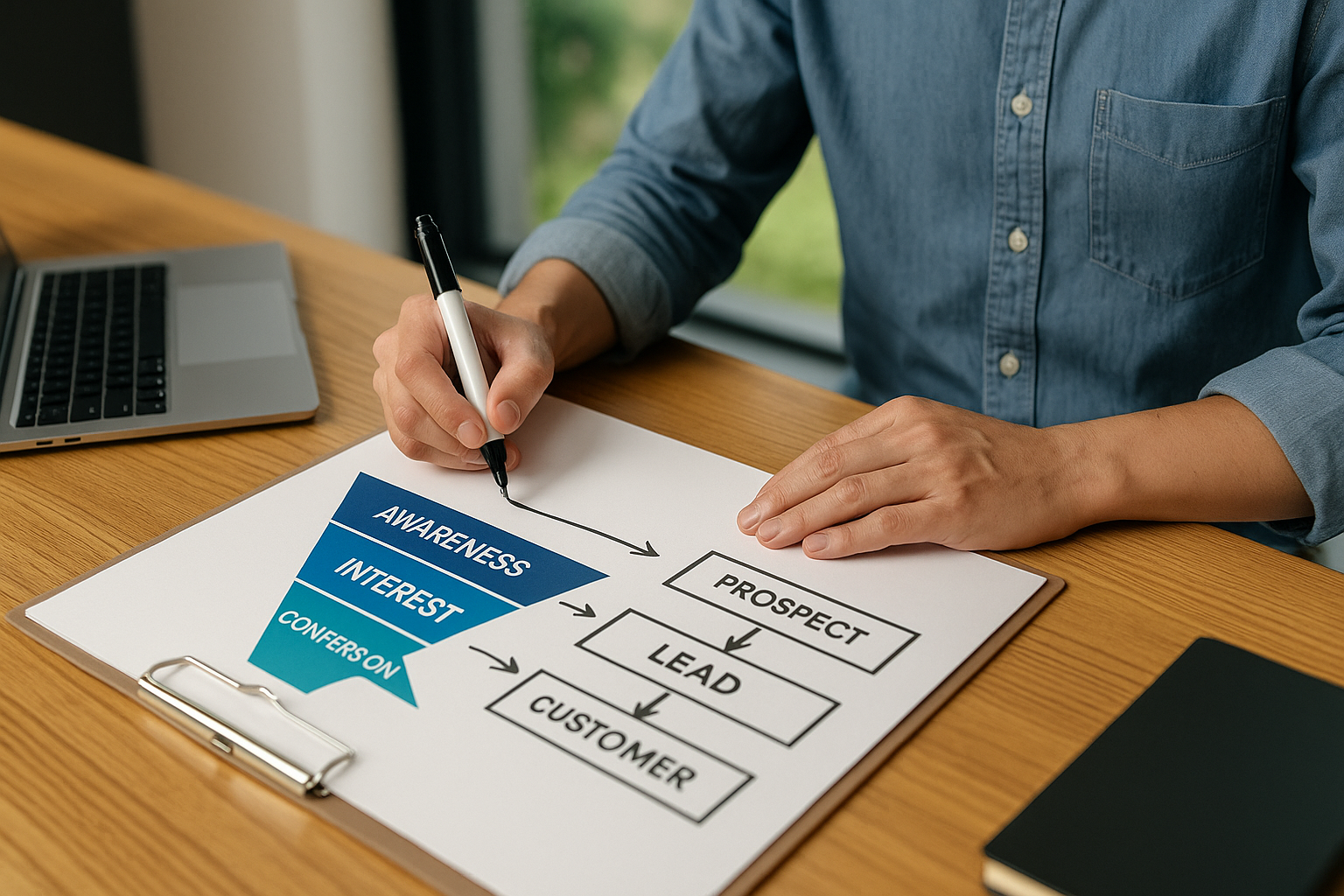
A sales funnel is the customer journey from the first interaction with your brand to the moment they become a paying client — and sometimes even beyond.
It’s typically divided into 4 basic stages:
- Awareness – They discover you exist
- Interest – They become curious about what you offer
- Decision – They consider buying
- Action – They buy
Each step is designed to move the user closer to the sale, with the right message at the right time.
Why You Need a Funnel (Even a Simple One)
Most website visitors won’t buy on their first visit. That’s a fact.
But with a funnel:
- You capture leads instead of losing them
- You nurture them through helpful content or offers
- You increase trust and familiarity
- You sell without being pushy
Without a funnel, your marketing is scattered. With a funnel, it’s intentional.
Step 1: Know Your Customer Journey
Before you build anything, take a few minutes to sketch your ideal buyer’s path:
- Where do they usually find you? (Instagram, blog, search?)
- What problem do they have?
- What would convince them to trust you?
- What objections might they have before buying?
Mapping this out will make the next steps more precise.
Step 2: Create a Lead Magnet
Your funnel starts by capturing attention — and email is still one of the best ways to do that.
But people don’t give away their email for nothing.
So offer a lead magnet:
- A free checklist
- A short PDF guide
- A mini video training
- A discount code or trial
Make sure it solves a specific pain point and offers quick value.
🛠 Tools to use:
- Mailchimp
- Systeme.io
- ConvertKit
- Brevo (ex-Sendinblue)
Step 3: Build a Landing Page
A landing page is a simple, focused web page with one goal — to get people to take action (usually, sign up or opt in).
Keep it simple:
- A headline that speaks directly to the user’s problem
- A few bullet points with benefits
- A clear, standout call-to-action button
- No distractions or extra links
Platforms like Carrd, Systeme.io, or WordPress plugins make this easy even if you don’t code.
Step 4: Deliver Value Automatically
After someone signs up, don’t ghost them. That’s when your automation begins.
Send:
- A welcome email
- The lead magnet promised
- A few follow-up emails over the week with tips, case studies, or free value
These emails build trust and warm up your audience before presenting your offer.
👉 Keep each email focused, short, and with one goal.
Step 5: Present Your Offer Clearly
Now that your lead knows you, it’s time to make the offer.
This can happen:
- In an email
- On a thank-you page
- Through a separate sales page
Structure the offer like this:
- Highlight the transformation/result
- Show testimonials or proof
- Handle objections (price, time, doubt)
- Include urgency (limited spots, bonus expiring)
A simple CTA like “Join Now” or “Get Access” with a clean checkout experience is enough to convert warm leads.
Step 6: Optimize Based on Data
Once your funnel is live, track key metrics:
- How many people visit the landing page?
- How many opt-in?
- How many open the emails?
- How many click the link to your offer?
- How many buy?
Start tweaking one element at a time — headline, CTA button, email subject — to improve performance.
Don’t expect perfection on day one. Funnels evolve.
Pro Tip: Keep It Simple and Focused
Don’t try to automate an empire on day one.
Start with:
- One lead magnet
- One landing page
- 3–4 follow-up emails
- One clear offer
You’ll be ahead of 90% of small businesses.
Final Take: Funnels Are Just Guided Conversations
Forget the buzzwords — a sales funnel is just a smart way to guide people through their decision-making process.
When done right, your funnel becomes:
- Your best salesperson
- A trust-building machine
- A scalable asset that works even when you sleep
Start with clarity. Deliver value. Then make the offer.